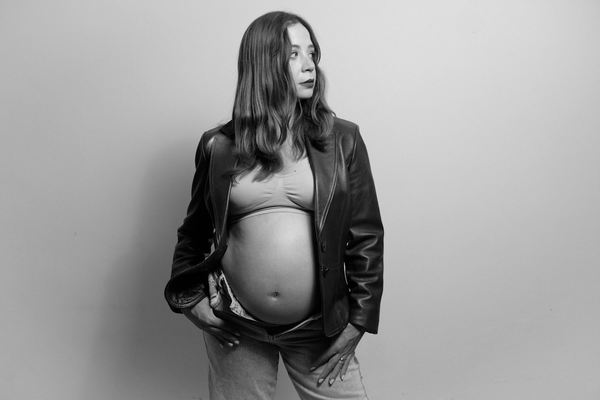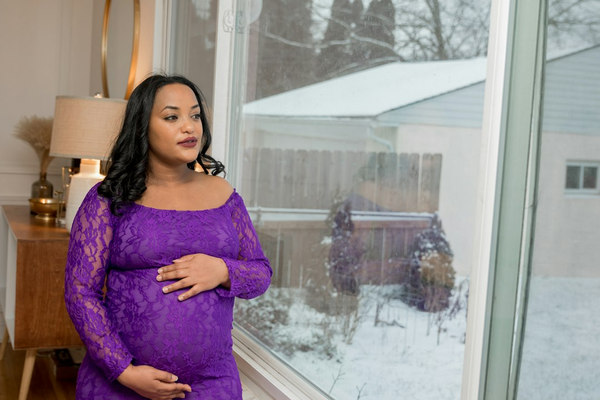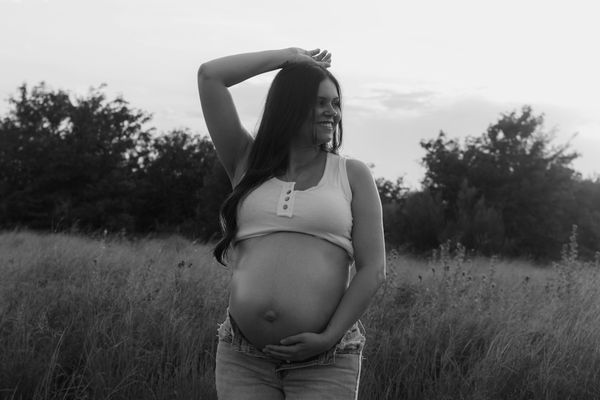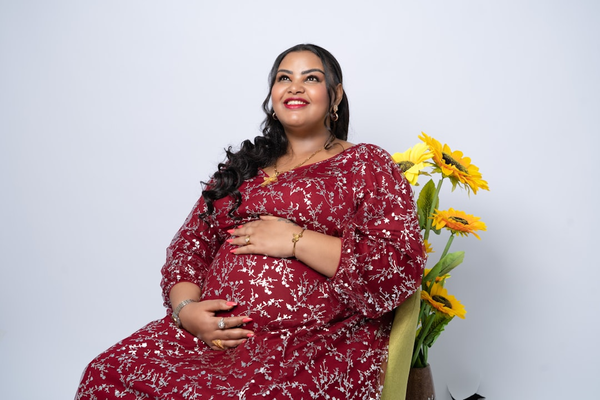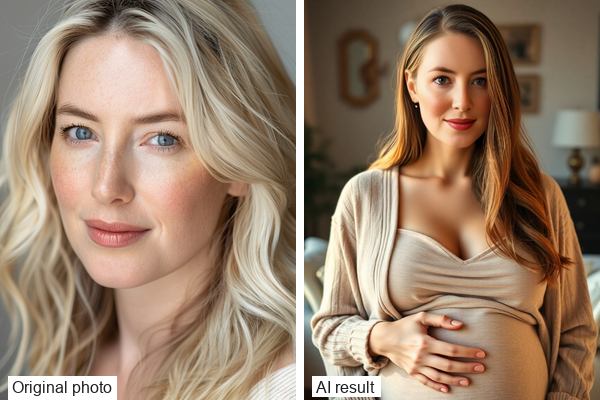
Short version: yes, AI maternity photos can look genuinely realistic — polished skin, natural lighting, a believable studio or lifestyle setting. What they don't do is replace the actual experience of being photographed while pregnant, and the result won't always match your original photo in every last detail. Above is a real, unedited before/after pulled directly from our own generator's example gallery, not a cherry-picked mockup, so you can judge the realism yourself before reading a word of marketing copy. Below: what that example actually shows, how AI output compares to a real photographer on cost, time, and control, and where a live session still wins outright.
Key takeaways
- AI maternity photos can look convincingly realistic in skin texture, lighting, and styling — but realism isn't the same as an exact, unedited match to your original photo
- In the example above, hair color and a few facial details shifted between the original and the AI result — a real limitation worth knowing before you try it
- A real photographer offers something AI structurally cannot: the in-person experience of being photographed while pregnant, with someone physically present for the moment
- AI maternity photos are worth it for cost, speed, and privacy; a real photographer is worth it for the experience itself and for guaranteed likeness accuracy
What the real example actually shows
The image at the top of this article is pulled straight from the "Original photo → AI result" example on our own generator page — the same one any visitor sees before uploading anything themselves. It's a fair, unretouched-for-marketing look at what the tool actually does, not a staged best-case scenario.
Looking at it closely: the skin tone, lighting, and overall photographic quality of the AI result are genuinely polished — closer to a styled indoor portrait than a phone snapshot. The warm window light, the soft focus on the background furniture, the natural-looking fabric folds in the cardigan — none of that reads as an obvious digital illustration, and that's the realistic part living up to the claim. But look again and you'll notice the hair color shifted from platinum blonde in the original to a warmer brunette/auburn in the result, and some facial details — the shape of the eyebrows, a slightly different eye color — aren't a pixel-perfect match either. The overall facial structure and expression are clearly recognizable as the same person, but "recognizable" and "identical" aren't quite the same claim, and it's worth knowing which one you're actually getting before you upload your own photo expecting an exact copy with a new background.
How realistic are AI maternity photos, honestly?
"Realistic" is doing two different jobs when people ask this question, and they deserve separate answers:
- Does it look like a real photograph, rather than an obvious digital illustration? Generally, yes. Modern AI portrait generation produces convincing skin texture, natural-looking light and shadow, and believable settings — this is the part most people mean when they ask if AI maternity photos "look real."
- Does it look exactly like you, matching your specific features precisely? Less reliably. As the example above shows, details like hair color, eyebrow shape, or subtle facial proportions can shift during generation. The system is restyling your portrait, not tracing it — some drift in secondary details is a real possibility, not a hypothetical edge case.
A quick checklist for judging realism yourself
You don't need to take a company's word for how realistic its results are — a handful of specific details tend to give away AI generation across any tool, not just maternity photo apps. Worth checking on any AI-generated portrait, including ones from this site: whether hands connect naturally to the wrist and whether rings or bracelets behave consistently rather than merging into skin; whether teeth, hairlines, and clothing seams meet the body cleanly; whether any reflections (a mirror, a window, a polished surface) match the lighting direction on the person's face; and whether shadows on the subject point the same way as shadows on the background (Endertech). No single one of these proves anything on its own — a slightly odd shadow doesn't make a photo fake — but a cluster of them together is a reasonable signal to look closer.
What's separate from all of that, and worth calling out on its own, is the kind of drift shown in the example above: not a rendering glitch like a sixth finger, but a stylistic reinterpretation — a different hair color, a slightly different eyebrow shape. That's not the system "failing," exactly; it's a reflection of how these tools work. They're generating a new image informed by your photo, not tracing over it pixel by pixel, so some creative drift in secondary details is part of how the technology functions, not a bug specific to one bad generation.
AI vs a real photographer: side-by-side
Here's how the two actually compare, point by point.
Cost
- AI maternity photo: Free tier, then a few dollars per set
- Real photographer: $250–$1,500+ per session
Time
- AI maternity photo: Minutes, from a photo you already have
- Real photographer: A scheduled session, usually 1–2 hours, plus editing turnaround
Where
- AI maternity photo: Anywhere, from your phone
- Real photographer: In person, at a studio or location
Likeness accuracy
- AI maternity photo: Generally close, but secondary details like hair and exact features can shift
- Real photographer: Exact — it's actually you, photographed in real time
Posing and direction
- AI maternity photo: None needed — you pick the source photo
- Real photographer: Live guidance from someone experienced at posing pregnant bodies
The experience itself
- AI maternity photo: None — there's no session to remember
- Real photographer: A real, shared moment, often with a partner present
Retries
- AI maternity photo: Unlimited, private, no awkwardness
- Real photographer: Limited to what's shot that day
Multiple people in one photo
- AI maternity photo: Not from separate photos — the other person needs to already be in the source image
- Real photographer: Yes, naturally
The experience a real photographer offers that AI structurally can't
This is worth saying plainly rather than glossing over: no AI tool can replace the actual experience of a maternity photoshoot — being physically present with a photographer who's coaching your pose in real time, sharing the moment with a partner who's there in the room, feeling the specific version of nervous-and-excited that comes with being photographed while visibly pregnant. That's not a technical limitation that a future model update fixes; it's a category difference. An AI-generated portrait gives you an image. A live session gives you an image and a memory of the day it was made, which for a lot of people is a meaningful part of what a maternity photoshoot is actually for.
If that live experience matters more to you than convenience or cost, a real photographer is the right call, full stop — no honest comparison should suggest otherwise. There's also a practical dimension to this that's easy to overlook: a real photographer brings professional lighting equipment, years of experience posing pregnant bodies specifically, and the ability to adapt on the spot if a planned shot isn't working — none of which an AI tool is doing, since it isn't shooting anything at all, only restyling an image that already exists.
Turning a normal photo into something more polished
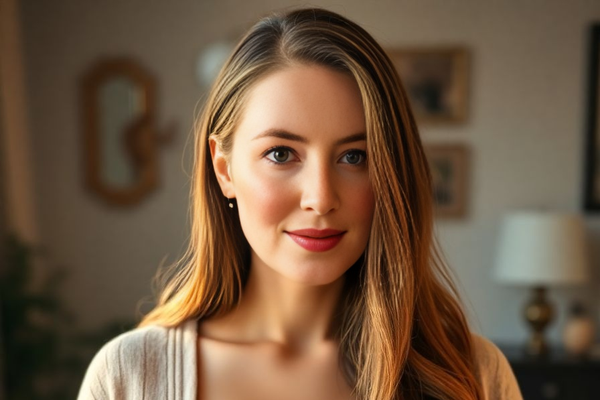
If what you actually want is a nicer-looking photo rather than the photoshoot experience itself, this is where AI maternity photo apps do something genuinely useful: they take an ordinary photo — a selfie, a photo a partner snapped, anything with your face clearly visible — and restyle it with better lighting, a more considered setting, and a more polished overall look. On AI Maternity Photoshoot Lab, the process is: upload one clear, front-facing photo with good lighting, and the system generates a styled result from it. New accounts get 30 complimentary credits, and photos that don't meet the basic requirements are auto-blocked before any credits are used, so a failed attempt costs nothing.
The honest limitations, based on what the process actually does:
- Secondary details like hair color or exact facial proportions can shift during generation, as shown in the example above — treat the result as "recognizably you, restyled," not a guaranteed exact copy
- It works from a single portrait of one person; it can't combine a separate photo of a partner into the same generated image
- Result quality depends heavily on your source photo — sharp, well-lit, forward-facing shots produce cleaner results than dark or angled ones
- Like any AI-generated image, occasional small artifacts around hands or fabric are possible — trying more than one source photo is a reasonable way to land on a result you're happy with
Getting a result closer to how you actually look
If likeness accuracy matters to you specifically, a few practical choices improve your odds of a closer match:
- Use a recent, well-lit, front-facing photo. The system has more accurate information to work from when your face is clearly visible and evenly lit, rather than partially shadowed or at a steep angle.
- Don't assume your exact hair color and style will carry over perfectly. As the example above shows, this is one of the more likely details to shift — if it matters to you, treat any single result as a first draft rather than a final answer.
- Generate from more than one source photo if your first result feels off. Since a rejected or unusable attempt doesn't cost credits, trying two or three different photos and comparing results is a reasonable way to land on one that feels closest to you.
- Set your expectation as "a polished, recognizable version of me" rather than "an exact digital twin." That framing matches what the technology is actually built to do, and it's a fairer basis for judging whether a result is good than expecting pixel-perfect accuracy.
A hybrid approach is a legitimate option too
This doesn't have to be an either/or decision. Plenty of people reasonably do both: generate a quick AI portrait now, for free or a few dollars, as a low-stakes way to have something before the pregnancy ends — and still book a real photographer later in the pregnancy, or during a later one, when budget and schedule allow for the full live experience. Using AI doesn't use up or diminish the option to also have a traditional session; it's a genuinely separate category of output, not a cheaper substitute you have to choose instead of the "real" thing.
Is it actually worth it?
Worth it, if: you want a polished-looking maternity portrait without the cost or scheduling of a live session, you'd rather not be photographed by someone you don't know, or you're working from a photo taken during a pregnancy you can't retroactively schedule a session for.
Not the right tool, if: what you actually want is the live experience of a maternity photoshoot itself, you need an exact, unaltered likeness rather than a restyled one, or you specifically want a photo of you and a partner together that wasn't already captured that way in your source image.
Both are legitimate answers. That's the actual point here, not a sales pitch dressed up as a comparison. The right choice comes down to whether you're solving for a nice photo or for an experience — get clear with yourself on which one you actually want, and you'll avoid being disappointed by a tool that was never trying to do the other thing anyway.
Frequently asked questions
Q. Are AI maternity photos realistic? A. In terms of photographic quality — skin, lighting, setting — generally yes, as shown in the real example above. In terms of matching your exact original features, less consistently; secondary details like hair color can shift during generation.
Q. Are AI maternity photos worth it? A. Worth it if you value speed, low cost, and privacy over the in-person photoshoot experience. Not the right fit if the live experience itself, or an exact unaltered likeness, is what you actually want.
Q. How do AI maternity photos compare to a real photographer? A. AI wins on cost, speed, and convenience. A real photographer wins on the in-person experience, guaranteed likeness accuracy, and the ability to naturally include multiple people in one photo. Neither is objectively better — they serve different needs.
Q. Can I turn a normal selfie into an AI maternity photoshoot? A. Yes. A clear, front-facing selfie with decent lighting is enough to generate a styled result — you don't need a professionally taken photo to start with.
Q. What's a good AI maternity photo app to try? A. Look for one that's upfront about its limitations (what it can and can't do, how source-photo quality affects results) rather than just showing polished marketing examples — that transparency is usually a decent signal of how the tool will perform on your own photo.
Q. How do I turn a normal pregnancy photo into something more professional-looking? A. Upload a clear, well-lit photo where your face is visible to an AI maternity photo generator, and it will restyle it with improved lighting, setting, and overall polish — no live session or professional camera required.
Q. Will the AI result look exactly like me? A. It should be clearly recognizable as you, but not necessarily an exact match in every detail — hair color and some facial specifics can shift during generation, as shown in the real example in this article. Think of it as a polished, restyled version of your photo rather than a precise digital copy.
Q. Can I do both an AI photo and a real photoshoot? A. Yes, and plenty of people do. Trying an AI-generated portrait doesn't use up or replace the option of booking a real photographer later — they're separate outputs serving different purposes, not competing choices you have to pick one of.